Two weeks ago our coordinators shared an enjoyable report on Europe for Scotland’s pioneering event in the European Parliament. It comes at a significant time for Britain, as the world too changes fast and furiously.
We need to re-assess. There are great dangers from the rise of a tremendously well-funded far-right. But also grounds for hope. I was at the Makerfield by-election won by Andy Burnham on 18 June, and he will soon be the UK’s Prime Minister. Immediately afterwards I joined Europe for Scotland in Brussels. I’d like to share some reflections and then ask you to support the renewal of its campaign.
An unprecedented panel
Along with Scotland’s ‘Yes for EU’ we marked the tenth anniversary of Brexit with an unprecedented, live-streamed discussion for nearly two hours in the European Parliament building.
Our day began to the mournful sound of bagpipes outside the vast Berlaymont building that houses the European Commission. They marked Scotland’s unjust eviction from the EU despite voting by 62 to 38 per cent to Remain.
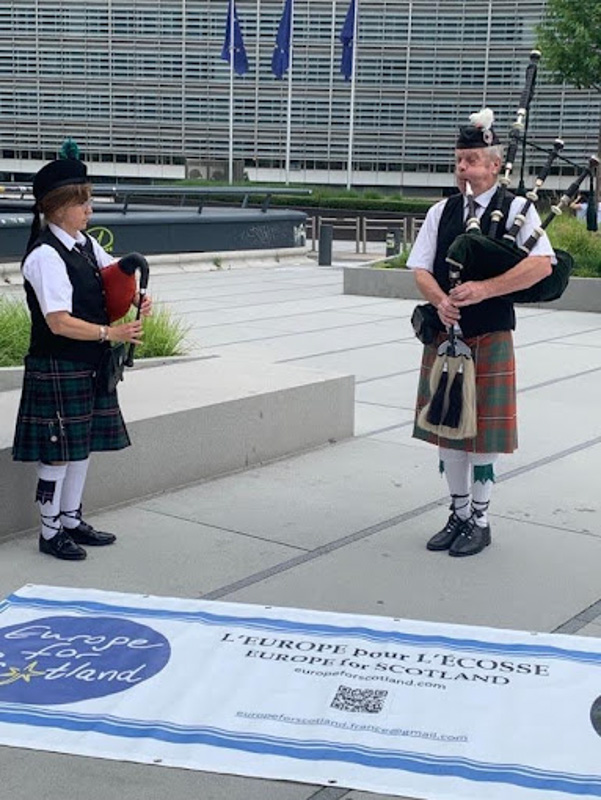
French and Flemish pipers playing before the European Commission 10 years after the Brexit referendum (Photo: ©Frédéric Pétry).
The panel had four speakers: Philippa Whitford, a retired surgeon who has worked in Gaza and was a leading Scottish National Party MP in Westminster from 2015 to 2024; Jill Evans, who was a Plaid MEP, representing Wales in Brussels for twenty years, until Brexit forced her out in 2020; and Lynn Boylan, an experienced Sinn Féin MEP for Dublin; I was the only non-politician. We also had a warming video contribution from Terry Reintke, Green MEP and former Spitzenkandidat. Our chair was Europe for Scotland coordinator Andrea Pisauro.
Why unprecedented? Not because there were speakers from Ireland, Wales, Scotland and England, although that is rare enough! But because all three of the Celtic speakers represented parties that are pro-independence, pro-EU, and are in power.
Such a panel could never have happened before. To give you an idea of how historic it is: Labour have governed in Wales for over a hundred years. No modern political party has dominated any territory so continuously anywhere else on earth. It did so until May. Then Plaid Cymru won and Labour came third behind the far-right Reform.
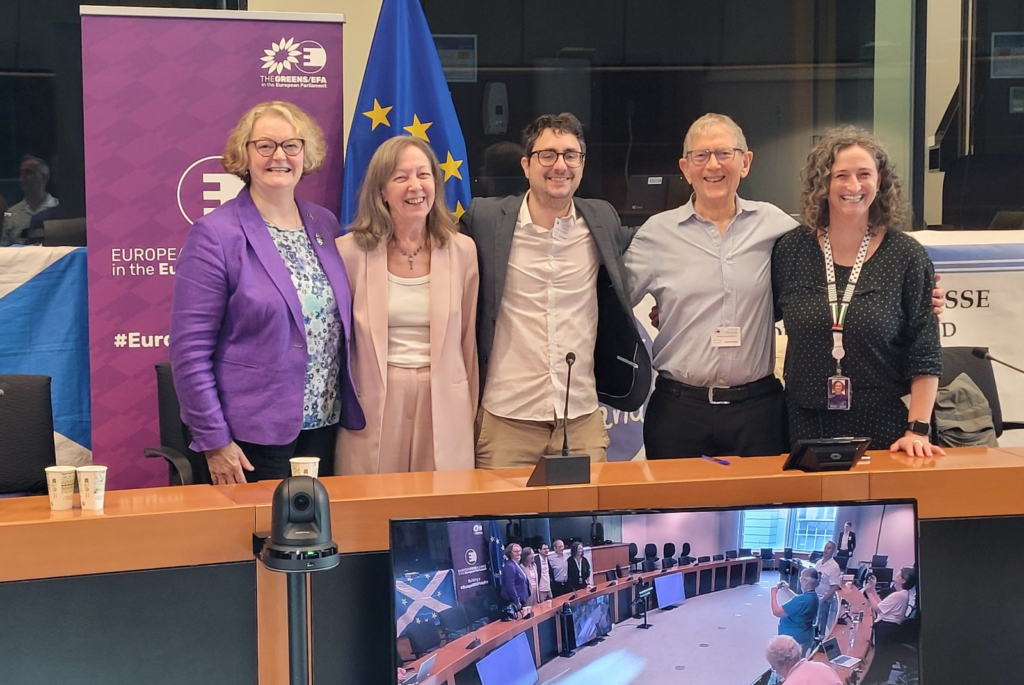
The speakers of the debate. (Photo: ©Frédéric Pétry). Have you missed it? You can watch it here.
Not only Plaid has its tail up. After Labour won the UK general election in 2024 it expected its Scottish Party to sweep aside the SNP this year. After all, the SNP was tired after being in power in Edinburgh since 2007 and mired in a leadership scandal. Instead, the SNP won a fresh mandate with 58 MSPs, while Labour gained only 17, an equal number to the far-right Reform. The Greens, who support independence, won 15.
The results in Scotland and Wales are part of a wave of profound discontent sweeping the UK. It has driven the Prime Minister from office. All the attention at the moment is on Andy Burnham. However, beware of England’s longing for ‘change’. Much of it is now for real. But also what is projected onto him is a desire that he refresh the status quo. Not least by keeping ‘Great Britain’ in one piece. There is almost no discussion of the challenge of civic nationalist movements in Scotland, Wales and Ireland. Yet they already express the inclusive ‘politics of place’ Burnham rightly wants to see across England.
So, while democrats in England face the fight of our lives against the far-right, a trans-British ‘Celtic’ politics of inclusive, civic nationalism is already democratically elected and in government in our three sister nations.
Europe for Scotland’s Brussels panel was a pioneering harbinger of its emergence.
It follows that how Europe for Scotland campaigns for the EU to welcome the return of Scotland needs to respond to this historic change.
What’s different?
For me, a stand out moment of the panel discussion was when Lynn Boylan said that Sinn Féin didn’t want the re-unification of Ireland to mean the North being absorbed into the existing Ireland (along the lines of German unification). They want a new kind of joint republic. In particular, they wanted the Dublin government to replace its privatised medicine with an NHS to ensure a social democratic Ireland.
This inspired me to think about how the re-unification of Scotland with the EU will also be new and different. Europe for Scotland started in 2021 as a European-wide protest against the injustice of a nation being hauled out of the EU against its will. Thousands of us joined a list of public figures from every European country to sign a letter that called on the EU to give Scotland a path back if it so wishes.
At the time, this call for Scottish independence felt much like that of the 2014 referendum. The call was defiant and Scotland was alone. Indeed, at that time British leaders said that as an EU member state they would veto any Scottish request to join, so a Yes vote meant Scotland being on its own outside the EU.
All nationalist movements need a healthy sense of defiance and self-belief. This does not prevent them having allies. The YES to independence vote was anti-Westminster, not ‘anti-English’. But in 2014 there was no credible allied party in England that shared an opposition to Westminster, while the nationalist movements in Wales and Ireland were relatively powerless.
Today, as Fintan O’Toole put it in a memorable phrase, Scottish independence is linked to influential forces across the whole “archipelago”. As it seeks to join the EU as a member state in its own right, Edinburgh finds an ally in Dublin, is supported in Belfast and Cardiff, and has the backing of the Green Party in England.
Europe has changed even more. In the aftermath of Brexit, an injured EU sought to defend itself in the negotiations. It was unthinkable that it might provoke the Westminster government by reaching out to Scotland. Today, the mood in Europe is expansive: towards Ukraine and Moldova and other candidate countries negotiating accession. These may soon include Iceland. Also, now that the UK is outside the EU, no country will veto Scotland’s joining if it became independent legally.
Another, deeper change has taken place in the EU. Those who campaigned for Brexit were obsessed with the threat to British sovereignty posed by the EU’s constitutional claim of “ever closer union”. So in its negotiations with the then British PM David Cameron for new terms to put to the referendum, the EU agreed this would not in future apply to the UK. The Brexiteers dismissed the concession. They hated the EU anyway. But it was a remarkable offer. Why was it made so easily? My guess is that the major EU countries did not believe in it and also opposed the idea of their disappearance into a federal EU ‘super-state’.
What’s next
Today, it is clear: the nature of the EU is that of a multi-national entity. One that, however imperfect, can be supremely good at regulating for the benefit of all. But as a shared European home for distinct nations. A natural home, therefore, for all four nations of the British archipelago.
Our call as Europeans, whether we are EU citizens or only UK citizens, should be for the renewal of Scotland’s EU membership in this framework. It remains a call for solidarity with Scotland’s demand for independence. But today it is also one for our shared European inter-dependence that includes Ireland and Wales and challenges England to join us.
In this spirit I would like to ask you to please support our coordinators, Andrea Pisauro and Nina Jetter, an Italian and a German living in England; and our network of ambassadors, especially our lead French ambassador, Jane MacKinnon, who was with us in Brussels, and Sarah De Sanctis, our lead Italian ambassador working from Rome.
Sarah is now editing a book on Scotland’s future in Europe with contributions from all over the UK and the continent, including from the likes of Fintan O’Toole, Neal Ascherson and Kalypso Nikolaidis.
Europe for Scotland is a quite exceptional campaign. Its funding needs are modest but essential. If you can send 20 or 50 pounds or euros or a £5-or-less monthly standing order, please do so here.
Many thanks,
Anthony Barnett