Yesterday, Scottish First Minister John Swinney delivered his keynote speech at the SNP conference in Aberdeen, which we encourage to watch.
Swinney launched Choose Scotland, a new campaign to boost support for independence described by the SNP as the most sophisticated it has ever undertaken. He argued that 2026 marks a turning point in Scotland’s “journey towards statehood,” ready for “the world of today and the hopes of tomorrow”.
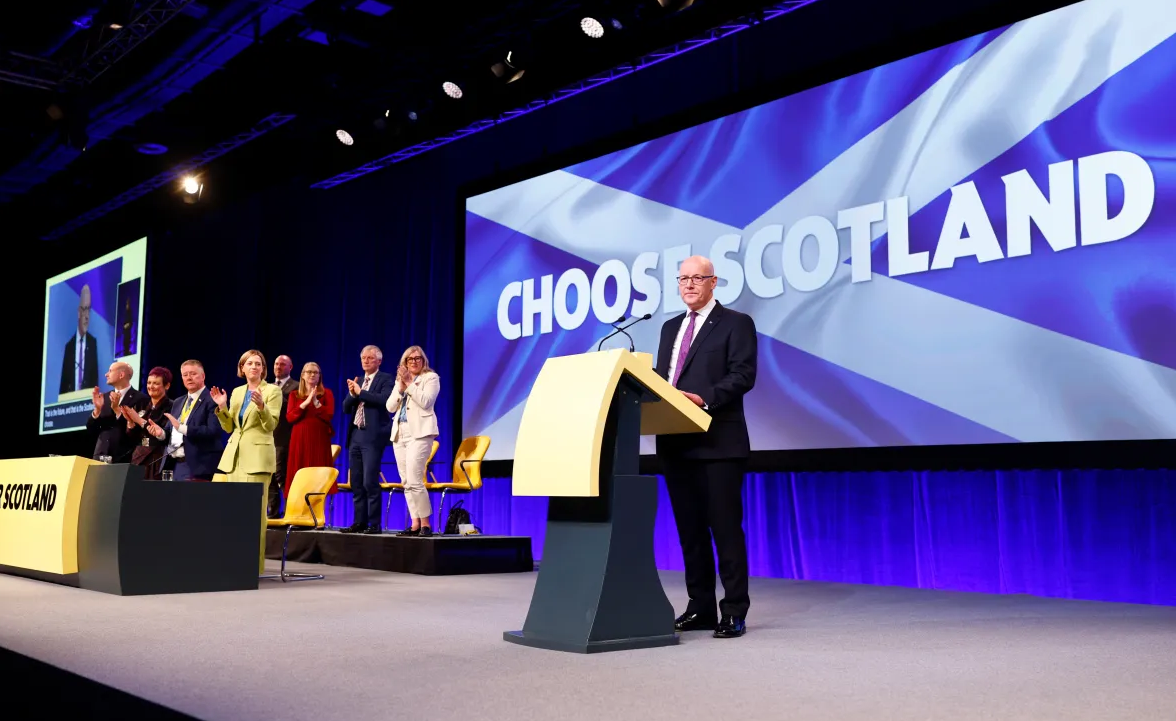
John Swinney, Scotland’s First Minister, addressing the SNP conference in Aberdeen. Photo: Jeff J Mitchell/Getty Images
We will come back to the many policies announced in Aberdeen, from public control of buses to the new Scotland Together Fund. But this week’s developments also raise a larger question: as Westminster begins to admit the scale of Britain’s Brexit mistake, is England finally catching up with what Scotland has long understood?
Been there, done that
A few weeks ago, in his first conference speech as Prime Minister, Andy Burnham said what many of us had waited years to hear: Brexit has failed, and Britain’s future lies closer to Europe. Days later, he acknowledged that Russia interfered in the 2016 referendum.
Much of the British media presented Andy Burnham’s speech as a burst of fresh, radical thinking: public control of water, a national care service free at the point of use, electoral reform, and a long-overdue reckoning with Brexit.
For many people in Scotland, however, much of this was neither fresh nor radical. As Lesley Riddoch put it, “almost all the Labour leader’s big wows have already been enacted in Scotland”. Scotland kept its water in public hands after the mass campaigns of the 1990s; it has provided free personal care since 2002; it rejected Brexit decisively in 2016; and it has used a more proportional voting system for its own parliament since devolution.
Burnham now proposes to reverse Thatcher’s disastrous decision to privatise water and begin a 10-year path towards “a very different water system” in England. He promises a National Care Service, free at the point of use, and says Labour will fight the next election on a commitment to proportional representation. These are significant pledges – including policy commitments we ourselves support – but they are not revolutionary policies in Scotland. They are, in large part, a late English translation of arguments Scotland has been making for decades.
You can’t live on nostalgia
Anthony Barnett’s response Burnham’s speech identifies its central contradiction. Burnham, Barnett writes, has ended “the political theatre of reality-denial” by naming deindustrialisation, deregulation, privatisation, austerity, and Brexit as causes of Britain’s crisis. The PM has stated plainly that Brexit has not worked, that it has produced a loss of control rather than its recovery, and that he personally wants it reversed. This is important.
But Burnham’s vision of the Union, Barnett says, remains unconvincing. Burnham invoked his father’s Britain – the NHS, trade unions, and resistance to fascism during WWII – as the country he believes in. But a credible future for the British nations can’t rest on nostalgia and needs to be grounded in self-determination.
Scotland and Wales already possess national parliaments; the question is not whether Westminster may manage the democratic aspirations of its English voters, but whether all people across the British islands can shape their own futures freely.
Europe for Scotland has always championed precisely that idea. Solidarity across these islands is possible – but only if it begins with respect for democratic choice, not with a Westminster assumption that the Union must be preserved regardless of what non-English voters want.
Better late than never
Burnham’s admission that Brexit has done more harm than good, and his promise to consider all options for a closer relationship with the EU, marks a major shift in British politics. Barnett argues that Burnham has at least moved the debate back onto what Tom Nairn called “the terrain of reality.”
Yet the reckoning remains incomplete. In an interview reported by The Guardian on 11 October, Burnham acknowledged that Russia interfered in the Brexit referendum – something that independent researchers, journalists and many Remain campaigners had warned about for years. The admission matters, but it should not be treated as a revelation. It is confirmation of what many people said at the time, often dismissed as alarmist or undemocratic. We’ll come back to this point in the future.
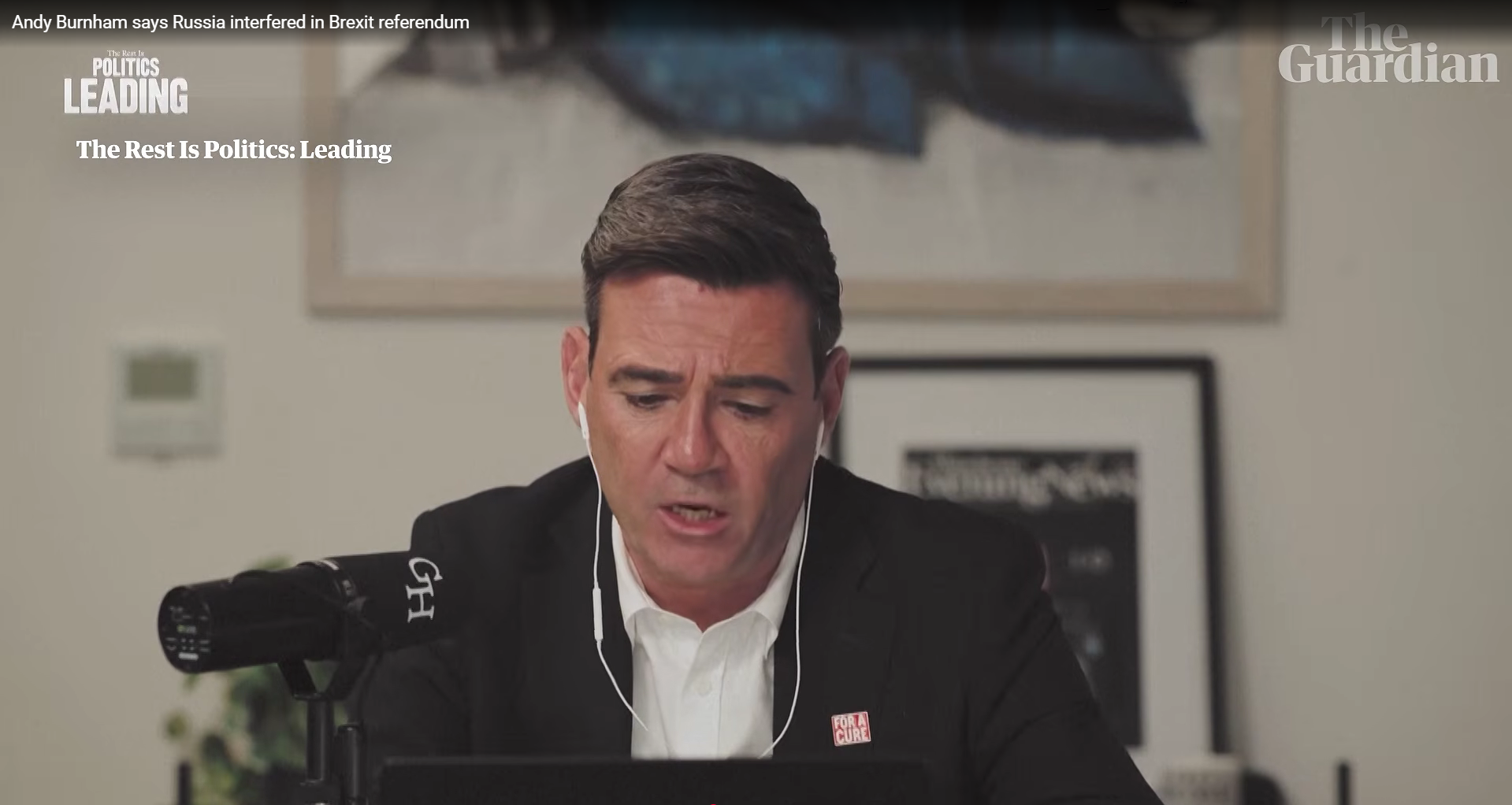
Click on the image to watch the moment in the interview with the podcast The Rest is Politics when the UK Prime Minister Andy Burnham admitted Russian interference in the Brexit vote.
For now Europeans should welcome Burnham’s recognition that Brexit was a mistake. But let’s not forget who called out that mistake first: the Scottish people.
In 2016, 62% of voters in Scotland backed Remain, and Brexit was rejected in every Scottish council area. Scotland’s warning was not merely about trade or travel; it was about the kind of country Scotland wants to be: internationalist, open and European.
That is the choice Swinney placed before the SNP conference yesterday. Burnham may be telling England what Scotland has long understood. The task now is to ensure that this belated awakening leads not to a refurbished British nostalgia, but to a democratic, European future – one in which Scotland’s voice, and Scotland’s choice, are fully respected.
In European solidarity
EfS Team
PS. Europe for Scotland is supporter-funded. If you value what we do, please forward this to one friend, or support our work here.